

Diesel Fuel Oxidation and Cetane Loss: Recognizing Fuel That’s Past Recovery
Diesel fuel oxidizes as it ages, especially in long-term storage, and that chemical change can’t be reversed by fuel polishing. Oxidation shows up as dark color, sour or solvent-like odor, and a rising acid number. Cetane, the fuel property that governs how readily diesel ignites, can decline over long storage independent of oxidation. Once either has progressed far enough, replacement is usually cheaper and more reliable than continued treatment.

Don’t risk thousands of dollars in failed equipment and lost time with old, oxidized fuel. A short-term cost savings of using old questionable fuel, is not worth the risk.
What Oxidation Is and Why Storage Time Matters
Diesel fuel is a mix of hydrocarbons that reacts slowly with oxygen over time, particularly during storage. This is a chemical process, not a contamination event. Nothing needs to get into the fuel for oxidation to occur. It happens on its own, and the rate depends on temperature, exposure to air, and how long the fuel sits.
Industry testing methods like ASTM D4625 accelerate this aging process under controlled heat to predict how a fuel will behave over months or years of real-world storage, which is one reason storage stability is treated as a measurable, trackable fuel property rather than a vague concern. As oxidation progresses, insoluble compounds form in the fuel. These are the same insolubles responsible for the dark, resinous deposits sometimes found in long-stored fuel tanks, separate from the sludge caused by water and microbial activity covered in our guide on tank sludge and corrosion.
How Oxidized Fuel Shows Up
A few signs point to oxidation rather than water or microbial contamination. Dark color is the most visible sign; fuel that’s noticeably darker than fresh product, without necessarily being cloudy or hazy, often points to oxidative aging rather than water intrusion. A sour or solvent-like odor, distinct from the rotten-egg smell associated with anaerobic microbial activity, suggests chemical changes in the fuel itself. And acid number climbing well above ASTM thresholds is the most reliable lab-confirmed indicator, since rising acid number tracks directly with oxidative degradation.
Any one of these alone isn’t necessarily conclusive. Together, and confirmed through testing, they point clearly at oxidation rather than a contamination issue that polishing could resolve.

Cetane Loss: A Separate but Related Problem
Cetane number measures how readily diesel fuel ignites under compression, and ASTM D975 sets a minimum cetane number of 40 for on-road diesel grades. Fuel can lose cetane through long storage, sometimes without failing other quality tests outright.
The practical symptom of cetane loss is hard starting and rough running, often across every piece of equipment drawing from the same tank, which is a useful diagnostic clue. If one engine runs poorly, suspect that engine. If every engine on a tank runs poorly the same way, suspect the fuel.
Cetane improver additives can help marginally, boosting ignition quality in fuel that’s drifted slightly low. They will not restore fuel that’s degraded significantly, and treating cetane improvers as a fix for badly aged fuel usually just delays a replacement decision that was already necessary.
Why Fuel Polishing Doesn’t Restore Oxidized Fuel or Improve Cetane
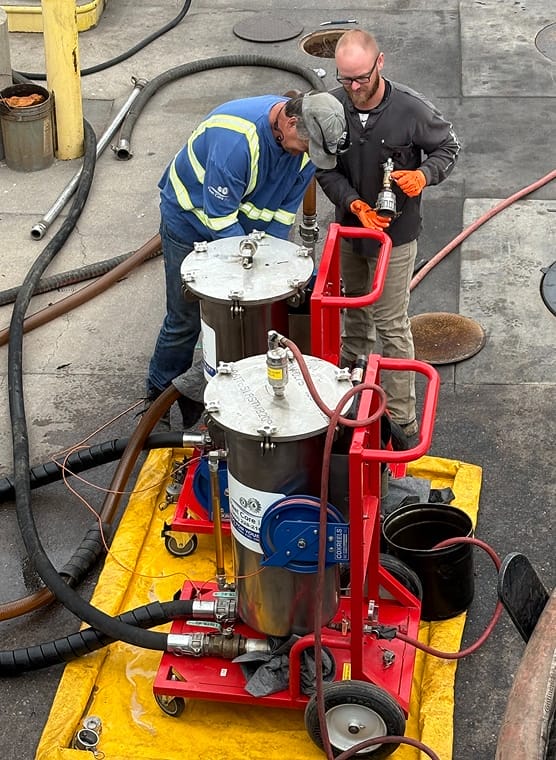
Fuel polishing works through filtration and separation. It removes water, particulates, and microbial load, which is why it’s effective against the contamination issues covered elsewhere in this series. Oxidation and cetane loss are chemical changes to the fuel molecules themselves. There’s nothing to filter out, because the fuel that’s there has changed at a chemical level, not picked up something foreign that can be separated back out.
This is the most important distinction in fuel treatment decisions. Contamination problems, water, particulates, microbial growth, are fixable through polishing. Degradation problems, oxidation and cetane loss, are not. Confusing the two leads to wasted polishing passes on fuel that was never going to test better afterward. Our full comparison of polishing, cleaning, and replacement lays out this decision framework in more detail.
When to Stop Treating and Start Replacing
A few situations point clearly toward replacement rather than continued treatment. Acid number results confirmed well outside ASTM thresholds mean the chemistry has already changed and won’t reverse. Hard starting and rough running across multiple pieces of equipment on the same tank, with cetane loss confirmed by testing, means an additive is unlikely to restore performance meaningfully. And fuel requiring many polishing passes to approach spec, without oxidation being the driver, often costs more in time and service visits than a straightforward pump-out and refill.
The math depends on fuel volume, current fuel cost, and how much downtime a replacement requires versus continued treatment attempts. Testing before committing to a path is what makes that math reliable instead of guesswork.